
Introduction to Plant Nutrition, Photosynthesis & The Mechanisms of Photosynthesis :
Table of Contents
Why Do Organisms Need Food?
All living organisms need food for their vital growth, development, and strength. Food is the most basic necessity of life. Every single organism requires energy to perform daily vital activities, and this energy comes directly from the food they consume.
The biological process of taking in, processing, and synthesizing food to generate energy is called Nutrition. In this guide, we will focus specifically on green plants and explore how they synthesize energy to feed themselves and the entire planet.
Modes of Nutrition in Plants :
Not all plants feed the same way. Broadly, there are two major types of nutrition modes found in the plant kingdom.
A) Autotrophic Nutrition (Autotrophs):
The name itself is self-descriptive: “Auto” means self, and “trophs” means nutrition. Therefore, autotrophs are organisms that manufacture their own food. They do this by utilizing inorganic substances. Depending on the energy source they use, autotrophs are divided into two types:
- Chemolithotrophs (Chemosynthetic):
These plants or organisms produce their food in the absence of sunlight by the oxidation of inorganic substances (like sulfur or iron).
- Photolithotrophs (Photosynthetic):
When plants capture and use Sunlight as their primary energy source to manufacture food, they are called photolithotrophs. These are commonly/every day green plants.
B) Heterotrophic Nutrition (Heterotrophs):
“Hetero” means others. These organisms cannot manufacture their own food and are completely dependent on other organisms or plants for their nutrition.
Examples: Certain bacteria, fungi, and even unique insectivorous plants (like the Venus Flytrap) that trap insects to fulfill their nitrogen and nutritional needs.
What is Photosynthesis?
Photosynthesis is the definitive characteristic feature of autotrophic green plants. In scientific terms, it is defined as:
Definition:
The formation of carbohydrates by green plants in the presence of sunlight, utilizing Carbon Dioxide (CO2) from the air and Water (H2O) from the soil, with Oxygen (O2) released as a vital byproduct.
During this process, the Photons of light are captured by the leaves or green parts of the plant and are successfully converted into stable chemical energy.
🧪 The Balanced Biochemical Equation:
To represent photosynthesis accurately at a molecular level, we use this balanced biochemical equation:

🌍 Global Photosynthesis: A Mind-Blowing Fact!
When we think of photosynthesis, we usually picture massive rainforests. But here is an astonishing fact about how global energy is actually harvested:
Marine Algae (90%): Ocean-dwelling algae and phytoplankton are responsible for synthesizing a whopping 90% of the total global photosynthesis. They are the true lungs of our planet!
Terrestrial Green Plants (10%): All the land-based green plants, forests, and crops combined synthesize only about 10% of global photosynthesis.
The Site of Photosynthesis: Inside the Green Factory
We know that photosynthesis happens in green plants, but where exactly does this magic take place at a cellular level? Let’s explore it:
- The Mesophyll Cells:
Photosynthesis primarily occurs within the mesophyll cells located inside the leaves. These cells are packed with specialized plant organelles called Chloroplasts—the main kitchen where food is manufactured.
- The Thylakoids (The Coin Stacks):
Inside each chloroplast, there are tiny, flattened, sac-like structures called thylakoids. These thylakoids are neatly arranged on top of each other, looking exactly like stacks of coins.
- Granum & Pigments:
A single stack of these coin-like thylakoids is called a Granum (plural: Grana). The membrane of these thylakoids contains chlorophyll and other essential photosynthetic pigments. This is the exact site where the light-driven photochemical reactions occur.
Evolution of the Mechanism: Old Theories vs. Modern Concept
The way we understand photosynthesis today didn’t happen overnight. Scientists spent decades debunking old myths to find the truth. Let’s look at how the theory evolved:
🚫 The Old Theories (And Why They Were Disproved)
The Formaldehyde Hypothesis:
Early theories suggested that 1 molecule of CO2 and H2O combined to form formaldehyde, which then polymerized into glucose(fructose).
The Limitation: This was quickly disproved because formaldehyde is highly toxic to living cells. If plants actually produced it internally, it would kill the plant itself!
The Equal Gas Volume Theory:
Another old belief stated that the exact amount of carbon dioxide absorbed by a plant is always equal to the amount of oxygen released. This too was later disapproved by detailed metabolic measurements.
The Source of Oxygen (The 1941 Breakthrough): When two scientist used water having isotopes of oxygen which is O18 during photosynthesis the the oxygen released is not O18 it’s O16 hence proved that in photosynthesis oxygen released from plants comes from the oxidation of water.
The Modern Mechanism of Photosynthesis
According to the modern concept, photosynthesis is a classic Redox Reaction where oxidation and reduction occur simultaneously.
Water (H2O) is Oxidized to release Oxygen. Carbon Dioxide (CO2) is Reduced to form Sugar (Carbohydrates).
This complex modern mechanism occurs strictly in two sequential steps:
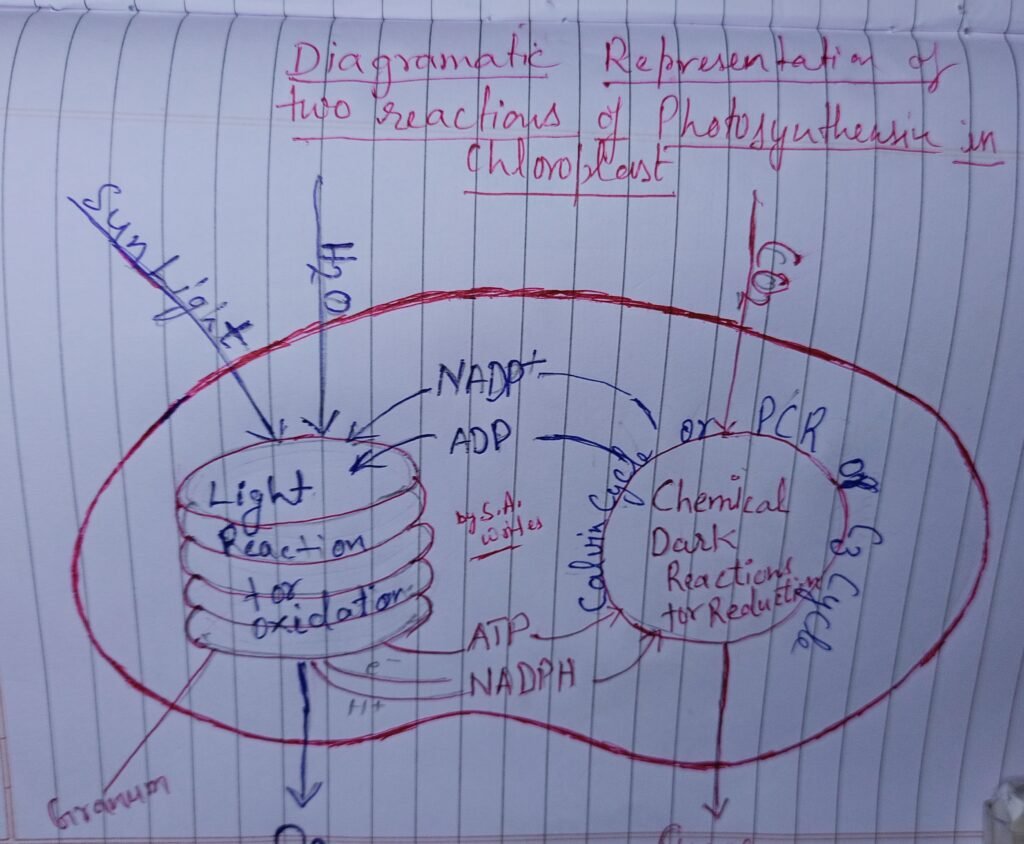
A) Light Reaction (Photochemical Oxidation Phase)
Location:
Occurs inside the Thylakoid membrane / Grana.
Process: The chlorophyll absorbs solar energy (photons) and converts it into stable chemical energy. Water is split (oxidized) during this phase.
End Products: Energy is stored inside specialized energy packets called ATP and NADPH2, while Oxygen(O2) is released as a byproduct.
B) Dark Reaction / Calvin Cycle (Light-Independent Reduction Phase)
Location:
Occurs inside the Stroma of the Chloroplast.
Process: This is a non-photochemical reduction process controlled by specialized plant enzymes. It does not directly require sunlight, meaning it can run as long as energy is available. Here, Carbon Dioxide (CO2) is successfully reduced into Carbohydrates (Glucose).
Energy Source: The cycle uses the ATP and NADPH2 produced during the Light Reaction as the fuel to drive this reduction.
Conclusion :
Food is necessary to surviving of all organisms, why we need food? For the restoration of energy we need food in plants they made their food by the processes of photosynthesis.
Photosynthesis is a beautifully synchronized two-step engine that runs on solar power, splits water in the grana, and fixes carbon in the stroma to feed the living world.
But wait! Do all plants perform this Calvin Cycle the exact same way? It turns out that when the weather gets brutally hot and dry, normal plants struggle to survive. To overcome this, some plants evolved an incredible metabolic superpower!
In our next post, we will dive deep into the fascinating world of C3 and C4 plants and uncover their survival secrets. Stay tuned!
What is the fundamental difference between chemolithotrophs & photolithotrophs
Chemolithotrophs(Iron & sulfur, ammonium bacteria) derive energy from inorganic substances in the absence of sunlight and photolithotrophs(green plant & BGA) derive energy in presence of sunlight.
Why Dark reaction called as ‘Dark’ even it doesn’t require darkness?
Because photosynthesis completed in to two steps one is light and another is dark reaction in light reaction ATP(in the presence of sunlight) &NADPH is produced due to oxidation then this ATP & NADPH is used in Dark reaction as fuel for reduction this step doesn’t need sunlight that’s why it called as ‘Dark Reaction’.
Why was the old theory of ‘formaldehyde toxicity’ is rejected?
This is a hypothetical theories believed by old scientist that plants converts carbon dioxide & water in to ‘Formaldehyde(HCHO)’ and then this polymerized in to glucose. This is not correct because formaldehyde is toxic to plant cells even in minute amount plant can Die.
Why is photosynthesis considered a Redox process?
Because photosynthesis is completed into two steps light reaction and dark reaction
In light reaction when light falls on chloroplast Water is oxidized in to Oxygen(O2) and loses electrons and hydrogen and this step is oxidation
In dark reaction Carbon dioxide(CO2) is reduced to form glucose(With the help of ATP & NADPH2) and this step is Reduction
when a chemical reaction have both reduction and oxidation simultaneously this type of reactions is known as Redox reaction that’s why photosynthesis is Redox process.